5 Questions to Ask Before Choosing a Math Tuition Centre
Question 1: Is This a Specialist or a Generalist Math Tuition Centre?
A centre teaching eight subjects divides its curriculum development, teacher training, and question bank updates among all eight subjects. None of those subjects receives the full weight of the team’s focus. A primary maths tuition centre that specialises in one subject concentrates entirely on that discipline, and that focus is evident in the quality of its materials and the depth of its teaching methods.
At Concept Math, mathematics is the only programme offered. With 15 years in the field since 2011 and as part of the Indigo Education Group, the team focuses on understanding how Singapore students engage with mathematical reasoning and where gaps consistently appear. That depth of subject focus is structurally difficult to replicate in a generalist setting.
When visiting a centre, find out: how many teachers work exclusively on primary maths, and how often are materials reviewed and updated? The answer reveals how the centre treats subject-specific depth.
Question 2: Are the Materials Updated for the 2026 Syllabus?
The 2026 PSLE Math syllabus revision is not simply a content reshuffle. SEAB’s updated papers carry a heavier load of ‘Novel’ questions, where the problem framing itself is unfamiliar and standard heuristics don’t apply. Any PSLE maths tuition programme that still uses pre-2021 worksheets is, in practical terms, preparing students for a different exam.
The more useful question to ask any centre is not whether they know about the syllabus change, but whether their lessons and question banks have been revised to reflect it. Specifically, are students being taught to handle unseen problem structures, or are lessons still built around recognising and reproducing familiar question types?
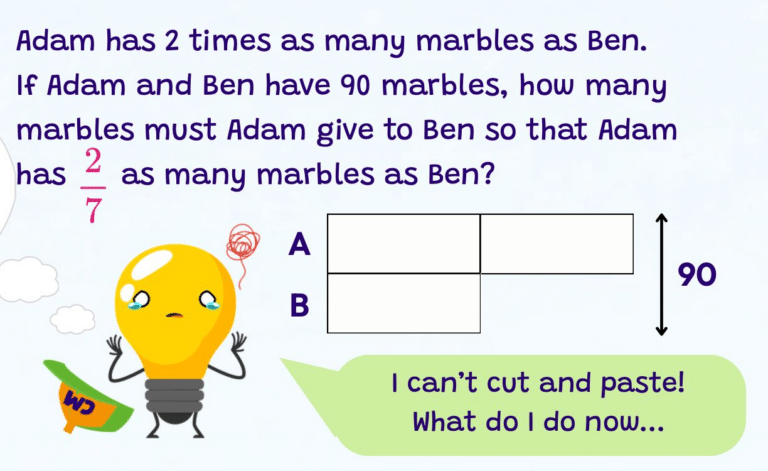
At Concept Math, the curriculum is built around concepts that transfer across topic areas rather than procedures tied to specific question formats. When a problem appears in an unfamiliar structure, a student who understands the underlying concept can still reason through it.
Question 3: What Digital Support Is Included?
A weekly class provides structured instruction. What happens at 9 pm the night before a test, when a concept isn’t sitting right, is a different question entirely.
Check whether the centre provides recorded lessons for home revision, and whether students have access to a portal with supplementary resources outside class time. These aren’t peripheral features. For students in the upper primary years, the ability to revisit a worked example independently is a genuine advantage, particularly in the weeks leading up to the PSLE.
Concept Math’s digital support gives students continued access to learning beyond the classroom. The parents’ portal and self-paced learning platform mean that when a concept doesn’t click in class, revision doesn’t have to wait until the following week’s session. For families looking to use school holidays productively, our maths holiday camp for kids extends the same structured approach into intensive short-course formats.
Question 4: How Consistent Is the Teaching Across All Classes?
A tuition centre’s quality is only as reliable as its least-experienced teacher on its least-prepared day. When individual tutors are free to teach in whatever way feels natural to them, students in different classes receive different terminology, strategies, and, occasionally, contradictory approaches to the same problem type. For students who transfer between classes or locations, that inconsistency creates compounding problems.
There is a second dimension of consistency that fewer parents think to check: whether the approach holds across levels and topics. Ask to see how the same concept is taught in Primary 3 and again in Primary 5. If the method shifts from one year to the next, a child is not building on what they already know. They are starting over. A well-designed curriculum picks one method per concept and applies it from P1 through P6, so the only thing that changes as a student progresses is the difficulty, not the framework. That continuity is what turns repeated practice into genuine mastery.
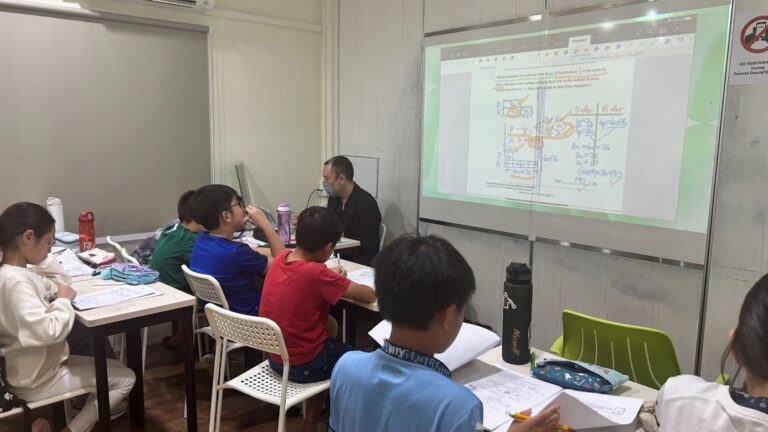
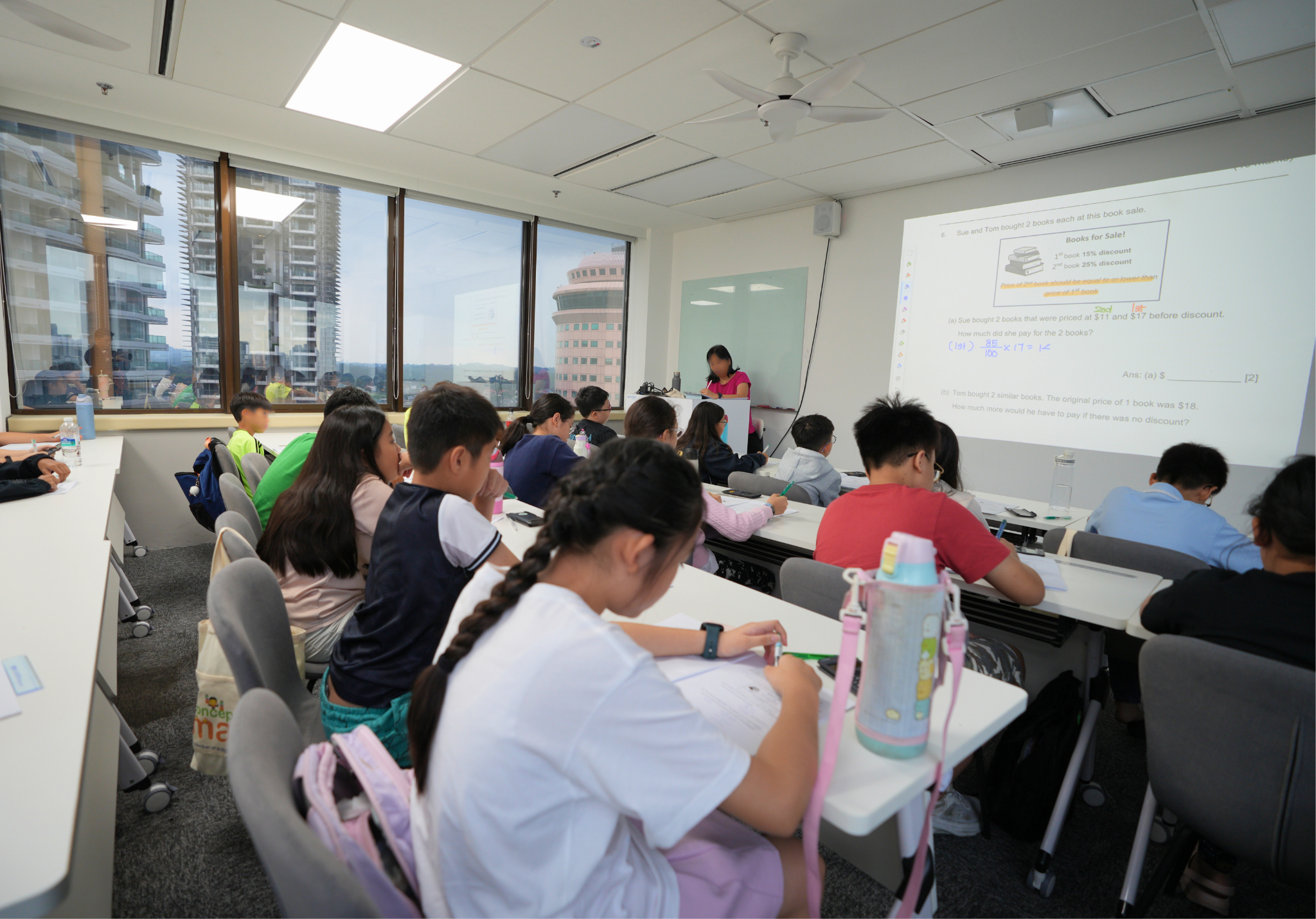
At Concept Math, every teacher is trained to deliver the S.M.A.R.T. methodology without deviation. Whether your child attends class at Novena, Bukit Timah, Parkway Parade, or Jurong, the approach is identical. That same consistency runs vertically through the curriculum: the conceptual framework a student learns in lower primary carries forward into upper primary, so each new topic reinforces and builds on a foundation already in place rather than replacing it.
The question to ask any math tuition centre: do teachers follow a common methodology, or does each teacher deliver their own version of the subject? And does that methodology stay the same as your child moves up each level, or does it shift?
Question 5: Does the Centre Teach Steps or Concepts?
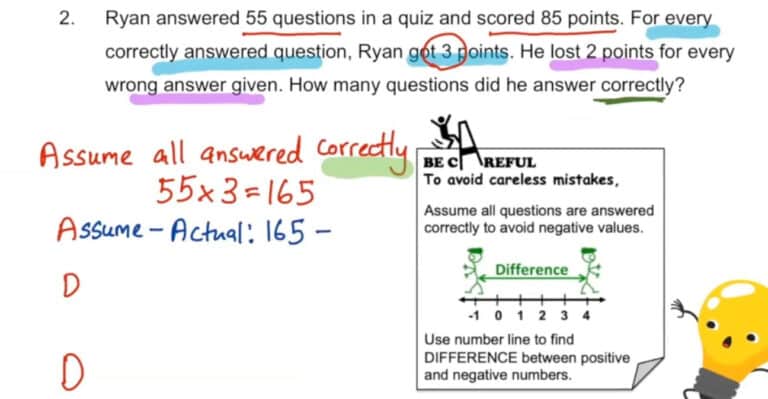
A student who has learned “Step 1, Step 2, Step 3” for a specific question type will often freeze when the same underlying problem appears in an unfamiliar format. That isn’t a failure of effort; it’s a gap in understanding.
Find out how a centre in Singapore handles non-routine questions. Do they give students additional procedures to memorise, or do they develop the conceptual clarity that makes new problem structures workable? The best math tuition centre for your child is not necessarily the one with the most worksheets; it’s the one that builds durable mathematical thinking rather than question-specific technique.
At Concept Math, progress is measured by whether a student can apply a concept to a question they have never seen before. That capacity, more than any memorised method, is what the 2026 PSLE format tests for.
Choose the Right Math Tuition Centre
These five questions take ten minutes to ask. A math tuition centre that answers all five clearly, specifically, and without deflection is one worth taking seriously. If you’d like to put them to us, feel free to contact our team.