Your Child’s P4 Fractions Grade Will Follow Them to P6
A P4 fractions grade is not really a P4 grade. It is a forecast of how a child will handle every proportional reasoning topic from P5 onward, including ratio, percentage, and the heuristics most heavily tested in the PSLE. The mistake shows up in P4. The end result is in the PSLE.
The ‘exam hall freeze’ that the P6 student is suffering from didn’t start that year. It started in P4, where a fraction concept was learned procedurally without ever being understood. The gap then sits quietly through P5, doing little visible damage to weekly assessments. The PSLE is where it surfaces, because it’s the first paper that tests the concept under enough pressure to reveal the cracks.
That is why fractions cannot be treated as a P4 topic in isolation. They are the conceptual backbone of every proportional reasoning topic the syllabus introduces afterward, and a gap at P4 level does not stay in P4.
What P4 Fractions Actually Introduce
The shift from P3 to P4 fractions is conceptual, not just procedural. In P3, fractions describe parts of a whole, and the child works with whole numbers around them. In P4, fractions become an operation. Students are asked to manipulate them, compare them, and apply them to sets and quantities.
Three specific shifts trip students up at this stage.
- Moving from like to unlike denominators. A child who has been adding fractions with the same denominator suddenly has to find a common one, and the procedure starts to feel arbitrary if the underlying concept has not landed.
- The difference between a fraction of a whole and a fraction of a set. Three-quarters of a pizza looks different on paper from three-quarters of 12 marbles, and students who can handle the first sometimes cannot handle the second.
- Operating with mixed numbers. Converting between mixed numbers and improper fractions is procedural, but the reasons to do it are conceptual, and that is where students drop off.
Faced with so many new shifts, many P4 students do what any learner under load would do. They reach for shortcuts. A child who hasn’t fully understood denominators learns to follow the steps anyway, copying their teacher without grasping foundational ideas. These coping strategies may sometimes produce correct answers on straightforward questions, but they break down the moment concepts are tested rather than steps.
The Thread from P4 to P6
To give students the grounding they need, the Singapore primary maths syllabus is built as a progression of topics. Each year deliberately follows from the conceptual work of the year before, so that understanding accumulates rather than restarts.
P4 fractions sit at the start of that chain. Then, percentages are introduced in P5 as a way of comparing quantities, but percentage problems are in fact fraction problems. A student who does not understand equivalent fractions will have difficulty grasping equivalent percentages, no matter their P5 maths class.
Ratio, introduced more fully in P6, is a fraction expressed differently. 80% and 4/5 are the same number wearing different clothes. The Remainder Concept, one of the most frequently tested PSLE heuristics, requires a student to track the fraction of the whole that remains after each step in a multi-stage problem. Without a solid understanding of fractions, this concept is nearly impossible to hold in working memory.
The Most Common P4 Fractions Mistakes
Three patterns recur in P4 fractions work, and parents who learn to spot them can act before the gap becomes entrenched.
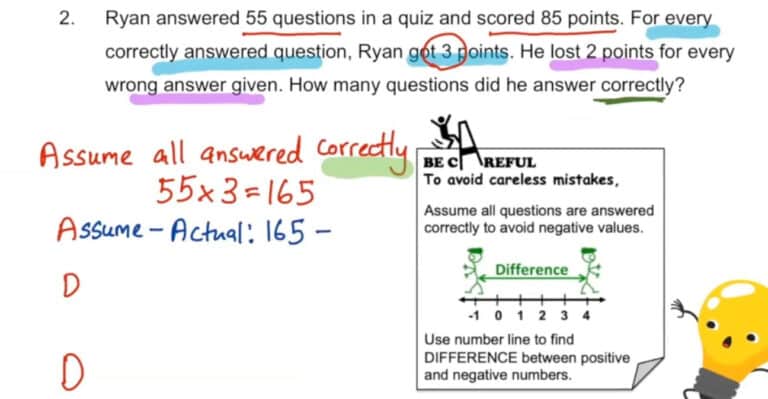
- Treating the numerator and denominator as two separate whole numbers. A child who adds 1/2 and 1/3 by writing 2/5 has not understood that in math, a fraction is one quantity, not two numbers stacked on top of each other.
- Confusing a fraction of a set with a fraction of a whole. A child can correctly identify three-quarters of a pizza and fail to find three-quarters of 12 marbles, because the second requires translating the fraction into an operation on a set. This distinction becomes critical in P5 ratio problems.
- Getting the right answer through an incorrect method. This creates false confidence. The teacher ticks the answer, and the misunderstanding stays invisible until a harder question exposes it. By then, the gap has had a year to entrench.
How Concept Math Addresses the Fraction Foundation

Our P4 maths tuition is built around the Concrete-Pictorial-Abstract progression, the same sequence the Singapore Ministry of Education uses to introduce abstract concepts at this level. Students start with physical or contextual representations of a fraction. They move to drawing models. Only once both have landed do they work with the abstract notation. The sequence is slow on purpose, as speed before understanding is what produces the workarounds that break in P5.
Model drawing does two jobs in our P4 fractions lessons. It is the visual tool that helps a student see the fraction and the diagnostic tool that shows a teacher exactly where understanding has broken down. A child who divides a bar into unequal parts has misunderstood the concept of the denominator. A child who shades correctly but cannot explain what the shaded portion represents has memorised a procedure without grounding it. Teachers can spot both at a glance, and the correction happens in the lesson, not after the next assessment.
Our primary school maths tuition programme treats P4 fractions as foundational work, not topic coverage. The aim is fluency that holds when the same concept reappears, restated, in P5 percentage and P6 ratio. A P4 student who leaves the year with solid fractions is set up for the next year.
Reading the P4 Grade Correctly
A P4 fractions grade is not a verdict on your child’s ability. It is a signal about where the foundation needs strengthening. Left alone, it becomes the reason a capable P6 student cannot finish Paper 2 in time.
The earlier this is addressed, the lighter the work. A child who closes a fractions gap at the start of P5 is doing the same conceptual work that PSLE maths tuition at P6 will otherwise have to repeat under far more pressure. The same applies to our maths holiday camp in Singapore, where children who need extra support on fractions can use the longer holiday sessions for targeted practice.
If your child is in P4 and fractions feel shaky, don’t wait for P5 to confirm it. Book a trial lesson at our tuition centres and let us identify exactly where the gap is.