What Are Heuristics in Primary Math, and When to Use Them
A parent leaves the school briefing with a new word in their notebook: heuristics. By the weekend, a heuristics workbook is on the kitchen table, and everyone thinks PSLE preparation is done. Then the first practice question doesn’t quite fit any of the strategies the workbook walked through, and the child stares at it for ten minutes.
At Concept Math, we call this the Checklist Trap. It is the belief that knowing what heuristics are is equivalent to knowing how to use them.
The trap is understandable. Schools teach heuristics by name, workbooks organise them by chapter, and the syllabus document lists them like ingredients. But the PSLE doesn’t test whether your child can name the strategy. It tests whether they can identify the right one when a question looks nothing like anything they’ve seen before.
The shift in mindset matters more than any workbook. The goal is not rote memorisation, but a child who knows how to think when a question doesn’t fit a familiar pattern.
What Heuristic Math is: Meaning and Examples
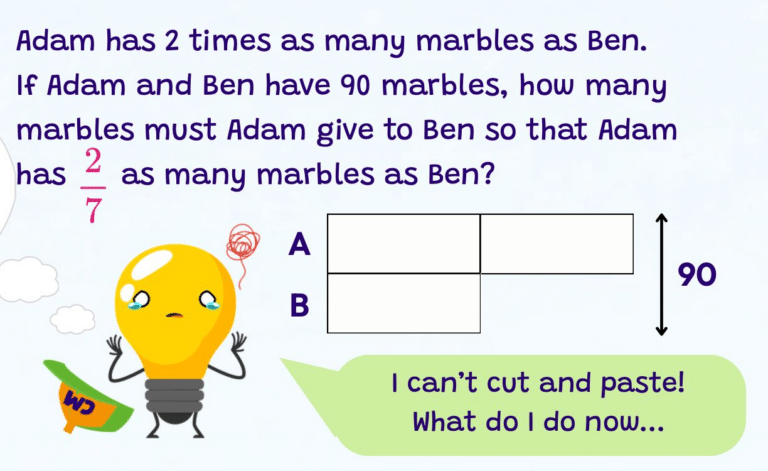
In plain language, heuristics are problem-solving strategies students use when there is no single formula to apply. Common heuristic math examples in primary school include Draw a Diagram, Work Backwards, Make a List, Guess and Check, and Look for Patterns. Each one is a way of approaching a problem when the path forward is not obvious.
Two clarifications are useful for parents.
Heuristics are not shortcuts. They do not bypass the underlying maths. They organise how a child enters a problem when the structure isn’t immediately clear, but they don’t solve the maths problem itself.
Second, heuristics are not topic-specific. A child who has practised Work Backwards only on questions like “After spending 2/5 of his money, John had $24 left. How much did he start with?” will not automatically recognise the same strategy in a question like “A tap fills a tank in 12 minutes. After running for some time, 3/4 of the tank is full. How long has it been running?” Parents and adults can see how the same problem-solving strategy applies to both, but the child won’t see that.
Today’s PSLE places heavier weight on heuristic-based questions for exactly this reason. The exam tests whether a student can read a new question, recognise what kind of thinking it calls for, and pick the right entry point. In fact, the questions are often written and phrased specifically to differ from the ones in assessment books, so the focus is on the child’s ability to think.
The Problem With Covering All of Them

The instinct, once a parent understands this, is often to drill every heuristic in sequence. The logic is reasonable. If heuristics matter, cover all of them.
The result is the opposite of what parents intend. Students who have been drilled through every named strategy often perform worse on unfamiliar questions, not better. They start asking “which heuristic is this?” before they’ve even understood what the question is asking. The thinking stops at strategy selection and never reaches the maths itself.
The real skill is the ability to read an unfamiliar question and know how to approach it. Drilling heuristics in isolation cannot teach this because drilling teaches the strategy without ever teaching recognition.
A toolbox analogy is useful here. Knowing the name of every tool in the box doesn’t tell you which one to pick up. What matters is understanding the job that needs to be done. A child who reaches for Guess and Check because the question feels hard, rather than because the structure of the problem calls for it, is using a tool without knowing what the job is.
What the PSLE Actually Rewards
The PSLE now rewards conceptual flexibility. This is the ability to recognise the underlying structure of a problem and adjust the approach as needed to solve it. The student doesn’t need to have seen that exact combination before. They need to be able to enter the problem, work out what is going on, and adapt when the first approach doesn’t deliver.
The difference between a student who scores AL1 and one who scores AL3 on the same paper often comes down to this. Both might know the same heuristics by name. Only one can deploy them.
Three thinking habits, in particular, are crucial for flexible thinking:
- Identifying what is known and what is unknown in the question, before reaching for any method
- Selecting an appropriate entry point into the problem, rather than defaulting to the most familiar one
- Adapting when the first approach doesn’t work, instead of restarting or giving up
These habits are built through structured, concept-first learning, not more assessment books. A good PSLE maths tutor works on the habits, not the labels.
How Concept Math Approaches This
No amount of drilling teaches a child which heuristic to choose for which problem. A child can name every strategy in the syllabus and still freeze on a question that combines two topics they haven’t seen combined before.
Our S.M.A.R.T. approach addresses this directly. It is a systematic problem-solving process that follows the primary school MOE framework for problem solving, integrating model drawing with concept identification and heuristic selection. The sequence matters. Students read the question first, identify the concept underneath, and only then reach for a strategy. S.M.A.R.T. works because conceptual understanding transfers across topics in a way that drilled procedures do not.
Our L.E.A.R.N. framework is the lesson structure that delivers it. Each lesson moves through five phases:
- Learn. Every lesson opens with a concept-anchoring activity. Videos, stories, and everyday examples provide context for maths before any procedure is introduced.
- Engage. Teachers walk students through worked examples step by step, then guide them through similar questions until the foundation is secure.
- Apply. Students move from textbook questions to heuristic problems that stretch their thinking, applying what they have understood to unfamiliar shapes.
- Reinforce. Timed in-class practice and structured homework consolidate the week’s learning so the concepts stick.
- Need help? Class recordings, homework walkthrough videos, and booster worksheets are available on our eClassroom portal for home revision.
The framework runs the same way at every level. Our P4 maths class in Singapore is for when the difficulty climb starts to bite. Our P5 maths tuition picks up the same structure as the concept load doubles. By Primary 6, the thinking habits are already in place when PSLE preparation begins.
The Real Goal
Heuristics are not a checklist to complete. They are a language for thinking. The goal is not for a child to have seen every heuristic. It is a child who knows what to do when they see something new.
The same thinking work continues outside term time, through our Maths holiday programme, which uses the longer sessions to deepen problem recognition rather than rush through more questions.
Want to find out how your child approaches an unfamiliar problem? Bring them in for a trial lesson at our Primary Maths tuition centres and see the S.M.A.R.T. approach in action.