How to Master PSLE Maths Paper 1 With Speed and Accuracy
Picture this: Your child sits down for their PSLE maths paper, flips open Booklet A, and works through the multiple-choice questions steadily. Then the invigilator announces: “Thirty minutes left.” The pencil hesitates. The mind blanks. Questions that should have taken forty-five seconds are now taking several minutes each.
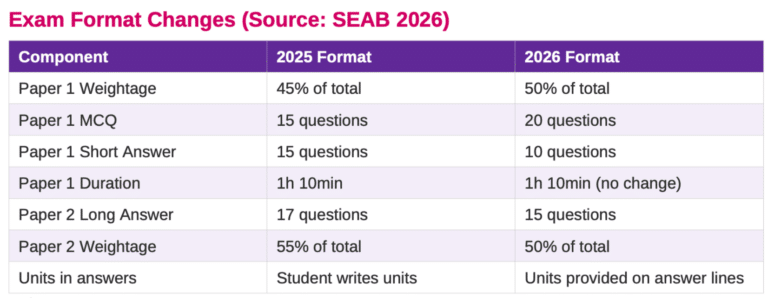
This isn’t a knowledge problem; it’s a speed problem, which is far more common than most parents realise. Here’s the part that surprises many families: Paper 1 now accounts for 50% of the total score. Yet in most households, and even in many tuition programmes, the bulk of revision time flows toward Paper 2.
At Concept Math, we see this imbalance every year and its consequences. At our PSLE maths tuition classes, we call Paper 1 the “confidence builder.” Win Paper 1, and you walk into Paper 2 with marks already banked, mental energy conserved, and the psychological momentum to tackle even the most demanding questions. Lose Paper 1 to slow, laboured arithmetic, and Paper 2 becomes an uphill battle before it has even begun.
The goal isn’t just accuracy. It’s the ability to build what we call a mental calculator: a set of internalised number skills so fluent that Booklet A becomes almost automatic, freeing every ounce of your child’s cognitive energy for the thinking-heavy problems that follow.
Building "Number Sense" for Paper 1
Speed without accuracy is recklessness. Accuracy without speed is insufficient. What PSLE Math Paper 1 demands is both, and the foundation for both is number sense: a deep, internalised familiarity with how numbers relate, convert, and behave.
Fraction–Decimal–Percentage Fluency
One of the single highest-return skills a primary maths student can develop is the ability to move fluidly between fractions, decimals, and percentages without reaching for a calculator, because in PSLE Math Paper 1, there’s no calculator to reach for.
Consider the difference between a student who sees “12.5%” and has to work backwards through long division, and a student who immediately recognises it as ⅛. The second student saves thirty seconds on that question alone. Across a paper with multiple percentage and fraction conversions, those savings compound into minutes; minutes that can be spent checking answers or working through a question that requires a second look.
At Concept Math, we build this fluency through targeted drills that treat the fraction–decimal–percentage relationship as a language. Students don’t calculate ¼ as a decimal; they know it’s 0.25, the way they know their own phone number. This is what genuine number sense looks like, and it’s teachable with the right structure.
The Art of Estimation
There’s a habit that strong Paper 1 performers share, and it’s simple: before committing to an answer, they ask, “Does this number make sense?”
This is an estimate, and it’s one of the most underutilised skills in the primary maths syllabus. A student who calculates that a rectangle with sides of 6 cm and 4 cm has an area of 240 cm² should feel an instinctive resistance before writing that answer down. The estimate says something is wrong, and the calculation confirms it.
We train students to build this sense of numerical plausibility, to develop an internal checkpoint between “I got an answer” and “I am confident this is correct.” In the PSLE maths paper, where it’s formatted as MCQ questions that offer no partial credit, this habit isn’t a nice-to-have; it’s a mark-saver.
The 1-Minute Rule
One of the most practical strategies we use in our primary maths tuition programme is the 1-Minute Rule: allocate no more than 60 seconds to a 1-mark question and no more than 2 minutes to a 2-mark question.
This sounds straightforward, but it requires deliberate practice to internalise. Students who have never timed themselves are often shocked to discover how long they actually spend on PSLE Math Paper 1 questions they consider “easy.” A 1-mark fraction question that feels quick might take 90 seconds, and at that rate, the duration runs out before the paper does.
The 1-Minute Rule isn’t about rushing; it’s about awareness. When a student knows their time budget per question, they make better decisions: they move on from a stuck question instead of burning 3 minutes on a single mark; they return with fresh eyes; and they finish the paper with time to check rather than scrambling to complete it.
Why Mental Accuracy Prevents Paper 2 Burnout
The connection between Paper 1 performance and Paper 2 performance is rarely discussed, but it’s one of the most important dynamics in the entire PSLE maths paper.
Energy Conservation
The human brain has a finite cognitive budget for any given situation. When a student spends that budget inefficiently, labouring over multiplication, converting fractions through long division, second-guessing every arithmetic step, they arrive at Paper 2 already depleted. The heuristics that require genuine strategic thinking, Before-and-After, Remainder Concept, and Equal Concept, demand a fresh, focused mind.
A student who’s mentally fatigued by the time they reach these questions is not just slower; they’re more error-prone, less creative in their approach, and more likely to abandon a question that they would otherwise be capable of solving.
The Confidence Snowball
There’s a psychological dimension to exam performance that’s rarely acknowledged in revision plans, but which any experienced tutor will recognise immediately: how your child feels in the first forty-five minutes of the exam shapes how they perform in the next ninety.
A student who moves through PSLE Math Paper 1 smoothly, answering with confidence, managing their time, and finishing Booklet A with a sense of control, carries that momentum into Paper 2. They sit down for the longer paper with the quiet assurance that they’re on track. That confidence isn’t incidental; it’s functional. It keeps the mind calm, the work organised, and the problem-solving instincts accessible.
Conversely, a student who struggles through Paper 1, who feels rushed, uncertain, and rattled by a question they couldn’t crack, walks into Paper 2 already on the back foot. The anxiety compounds, mistakes multiply, and questions that would have been manageable in a calm state become obstacles.
The Confidence Snowball is real, and it begins with Paper 1. This is why our maths holiday programme for kids dedicates focused sessions specifically to Paper 1 as the first step in exam preparation.
Stop Losing the Marks You Should Be Keeping
Top performers don’t just solve the hardest questions. They refuse to lose the easiest marks. Paper 1 is where those marks live. The fraction conversions, the percentage calculations, the straightforward geometry and measurement questions; these aren’t marks that require genius. They require fluency, speed, and a regular checking habit. They’re entirely within reach for the vast majority of students. The only reason children lose them is that no one has told them these marks need to be actively defended.
The PSLE maths paper rewards students who have prepared for both papers with equal seriousness, who walk into the exam with a mental calculator that handles Booklet A almost on autopilot, and a well-rested, confident mind ready to engage with the strategic demands of Paper 2.
That is the student Concept Math aims to nurture. Through structured Paper 1 drills, number fluency training, and the kind of small-group attention that ensures no gap goes unnoticed, we help students stop losing marks to speed and start converting every accessible question into the score they deserve.