P5 Math: Why Grades Usually Drop and How to Stop the Slide
Your child sailed through P4 with consistent AL1s and AL2s. Then the first P5 math test comes home, and the grade reads 60%. Nothing about your child changed overnight; what changed was the nature of the subject itself.
At Concept Math, we have worked with hundreds of P5 students, and we have seen this pattern consistently. It’s the point in the Singapore math journey where arithmetic ends and complex logical reasoning begins, where knowing how to calculate is no longer enough; students must learn to think.
The grade dip at P5 is not a failure. It’s a signal. And the parents who respond to it strategically are the ones who see their children recover, stabilise, and build the conceptual foundation they need for success.
The 3 Core Reasons Behind the P5 Grade Dip
Before diving into solutions, it helps to understand why the transition is so jarring. The Primary 5 math syllabus represents a significant structural shift; not just in difficulty, but in the type of thinking required.
1. The Leap From Arithmetic to Strategy
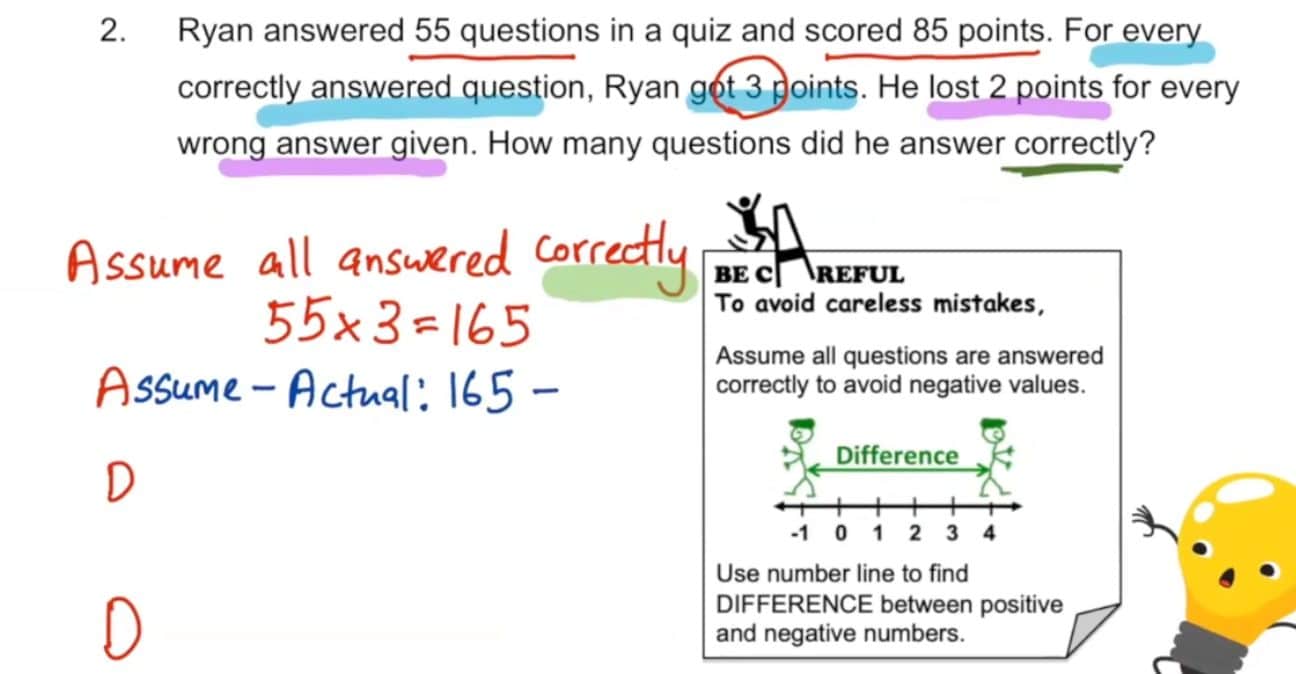
The P5 math syllabus introduces a new class of problem-solving methods that did not exist in P4. Concepts like Before-and-After, Constant Part, and Supposition (also known as the Assumption Method) cannot be solved through addition, subtraction, or even multiplication. Each of these requires a multi-step strategy: the student must first identify the correct method, then set it up and execute it, all within the context of a complex word problem.
In P4, a student who understood the numbers could usually figure out the operation. In P5, understanding the numbers is just the entry point. The real work is recognising which conceptual framework applies, and that is a skill that requires deliberate teaching, not just practice.
Consider the Supposition Method. A typical P5 math question might ask about a mixture of chickens and rabbits with a given number of heads and legs. Students who have only been drilled on arithmetic will attempt to guess-and-check their way to an answer. Students who have been taught the Supposition Method will set up a systematic model and arrive at the answer in under two minutes. The difference is not intelligence; it’s method.
2. The Time Management Trap
In P4, most students finish their math papers with time to spare. Questions are largely single-step or two-step, and the cognitive load is manageable. P5 changes this entirely.
Paper 2 in P5 introduces longer, multi-step questions that demand sustained concentration. A single question may require four or five logical steps; each one building on the last. If a student gets step two wrong, everything that follows collapses. And because each of these questions carries significant marks, leaving even one or two blank due to poor time management can affect the overall score.
The students who struggle most with time in P5 are often those who were too efficient in P4. They never developed the habit of pacing themselves, checking their work, or allocating mental energy across a paper. In P5, that gap becomes costly.
3. Cognitive Overload Disguised as Carelessness
Parents often tell us, “My child knows how to do it, but they just keep making careless mistakes.” We often hear this at our primary maths tuition centre. And while the intention behind this observation is kind, it often masks a more important truth.
When a student consistently makes errors at a specific step in a multi-stage problem, it’s rarely carelessness. It’s cognitive overload. The leap from one-step logic in P4 to four-step logic in P5 places an enormous demand on working memory. When the brain is juggling multiple variables, relationships, and operations simultaneously, it inevitably drops something, and that dropped element shows up as a “careless” mistake on the paper.
The solution is not to tell your child to “be more careful.” The solution is to reduce the cognitive load through better conceptual structure, which is exactly what the right P5 maths tuition class is designed to do.
Strategies to Stop the Slide
Understanding the problem is half the battle. Here are three structured approaches, drawn from our experience teaching the Primary 5 math syllabus, that consistently help students recover their footing.
1. Concept-First Revision
Before your child attempts a single question on a worksheet, ask them: “What concept is this?”
This sounds simple, but it’s one of the most powerful habits you can build. Is this a Ratio problem or a Fraction problem? Is it a Before-and-After scenario or a Constant Part scenario? Training students to classify a problem before solving it engages the strategic layer of thinking that P5 math demands. It also helps students catch themselves when they’re about to apply the wrong method.
At Concept Math, every lesson begins with identifying the concept. Students aren’t handed a question and told to solve it. They’re first asked to name what they see, which activates the right mental framework before the work even begins.
2. The 15-Minute Daily Drill
Paper 1 of the P5 math paper is where many students quietly lose marks they should be keeping. Because Paper 2 feels more intimidating, students and parents often over-invest revision time there, leaving Paper 1 practice thin.
The fix is a focused, daily 15-minute drill targeting Paper 1 skills: mental calculations, unit conversions, fraction operations, and basic geometry. The goal is not just accuracy; it’s speed and accuracy. When students can move through Paper 1 efficiently and confidently, they arrive at Paper 2 with more time, more mental energy, and more marks already secured. Think of it as buying back the time that Paper 2 questions will inevitably demand.
This is one of the tips for Primary 5 students in Concept Math: improve Paper 1 performance first, then build Paper 2 stamina on that basis.
3. Bridge the P4–P5 Gap
One of the most overlooked causes of the P5 dip is a shaky P4 foundation. The model drawing techniques introduced in P4 aren’t just P4 skills; they’re the scaffolding upon which P5 heuristics are built. A student who can draw a clear, accurate bar model for a comparison problem is far better equipped to adapt that model for Before-and-After and Constant Part problems in P5.
If your child is struggling with P5 math topics, it’s worth revisiting whether their P4 fundamentals, particularly fractions and ratios, are solid. This is why our P4 maths tuition programme is designed with an eye toward P5 readiness: we’re not just teaching P4 content, we’re laying the conceptual groundwork for what comes next.

How the S.M.A.R.T. Approach Stabilises Grades
At Concept Math, our five-step S.M.A.R.T. approach was built to address the conceptual transitions that P5 demands. It’s not a set of tricks; it’s a structured method for developing the deep reasoning skills that the revised PSLE math syllabus rewards.
Visual mastery sits at the core of our approach. We train every student to translate a word problem into a model before attempting to solve it; not to earn marks, but to think clearly. When a Before-and-After or Constant Part problem is mapped visually, the relationships between quantities become immediately visible, and the path to the answer follows naturally.
Equally important is the confidence that comes from small-group learning. In a class of six to eight students, there is space to ask “Why?” without embarrassment. When a student is confused by the Supposition Method, our tutors can address it immediately, before it becomes a recurring blind spot.
The P5 Dip Is a Launchpad, Not a Landing
Here’s the perspective shift that every parent of a P5 student needs: the grade dip isn’t the end of the story. It’s the beginning of the real one.
P5 is the foundation year for PSLE. Every lesson your child learns this year, every model they draw, every multi-step problem they work through, all of it becomes ammunition for the national examination. Students who navigate the P5 transition with the right conceptual tools don’t just recover their grades; they also improve their conceptual understanding. They arrive at P6 with a deeper, more flexible understanding of mathematics than students who coasted through P5 on memorised methods.
Worried about your child’s P5 transition? Bring them in for a diagnostic assessment and bridge their conceptual gaps today. Whether you’re preparing for the year ahead or looking for support right now, our maths holiday programmes are designed to help your child regain their footing.