PSLE Readiness Checklist for Success: The Ultimate Prep Guide Using the Concept Math L.E.A.R.N and S.M.A.R.T. Method
Key Takeaways:
- What are the L.E.A.R.N. and S.M.A.R.T Frameworks and Why Do They Matter in a PSLE Readiness Checklist?
- The L.E.A.R.N. Method:
L = Learn with real-life examples and interactive activities
E = Engage with guided exercises
A = Apply concepts to solve questions, including tough ones
R = Reinforce learning through drills and homework
N = Need Help? Support is always available
- The S.M.A.R.T. Method:
S = Simplify the question
M = Model using drawings or bar models
A = Analyse key concepts
R = Resolve with logical equations
T = Test the answer for accuracy
- How Do You Prepare Your Child Emotionally for the PSLE?
Mental readiness is just as crucial as academic prep. Include this in your PSLE readiness checklist:
- Light revision the night before
- No new topics, just flashcards or booster questions
- Keep the night routine calm and simple, with an early dinner and a full 8 to 9 hours of sleep
Introduction
As the PSLE exam draws near, it’s natural for parents to start wondering: Is my child really ready to take on this milestone? The truth is, preparation isn’t just about racing through past-year papers or memorising model answers. It’s about nurturing your child’s confidence, developing clarity in understanding, and building consistent study habits that support long-term success.
At Concept Math, we believe well-planned PSLE exam preparation begins long before the exam hall. Looking to help your child build effective study habits? This ultimate PSLE readiness checklist will come in handy, featuring our proven methods: the L.E.A.R.N and S.M.A.R.T frameworks.
PSLE Readiness Checklist: What are the L.E.A.R.N and S.M.A.R.T Frameworks?
At Concept Math, our L.E.A.R.N. approach builds deep understanding. Each step helps your child grow more confident and capable with math.
L = Learn: Concepts are introduced through fun activities, videos, and real-life examples.
E = Engage: Guided exercises to help build understanding.
A = Apply: Students solve problems using what they’ve learned, including higher-order questions.
R = Reinforce: Practice continues in class and at home with timed drills and regular homework.
N = Need Help?: Extra support is always available, so no child is left behind.
Meanwhile, the S.M.A.R.T. method equips students to tackle even the trickiest problem sums. As a parent, encourage your child to use the following steps even for basic sums. You will be impressed by how it improves consistency and reduces careless mistakes.
S = Simplify the question into smaller parts
M = Model the problem using drawings, arrows, or bar models
A = Analyse key concepts and choose the right strategy
R = Resolve with equations and step-by-step solutions
T = Test the answer for accuracy and logic
How to Build Academic Readiness
1. Mastering Core Concepts with L.E.A.R.N
Too often, students jump straight into their revision routine without understanding the “why” behind the math. However, to boost math enrichment for primary school, the process should begin with meaning instead of memorisation.
Concept Math’s L.E.A.R.N approach fosters long-term understanding by:
- Using real-life examples to relate math to everyday experiences.
- Teaching with engaging visuals and memory-building stories.
- Focusing on big ideas like place value, fractions, or geometry, before the formulas.
One useful parent tip to support your child towards academic success is to ask them to explain a concept like “area of a triangle” in their own words. If they can teach it, they’ve truly learned it.
2. Exposure to Different Question Types
PSLE math questions test more than accuracy. They challenge students to think critically across various formats:
- Multiple-choice logic puzzles
- Short-answer computational skills
- Open-ended problem-solving
That’s why the Engage and Apply phases of L.E.A.R.N expose students to a range of difficulties. We start with guided examples, then move to challenging PSLE-style sums.
How to Ensure Effective Mental and Emotional Prep
1. Create a Calm Pre-Exam Routine
One key element in the PSLE readiness checklist is to stay away from exam anxiety. The night before the PSLE should not be filled with panic. Keep booster questions short and sweet the night before. Also, encourage your child to:
- Focus on light revision or going through flashcards.
- Eat dinner early and sleep on time.
- Avoid learning anything new.
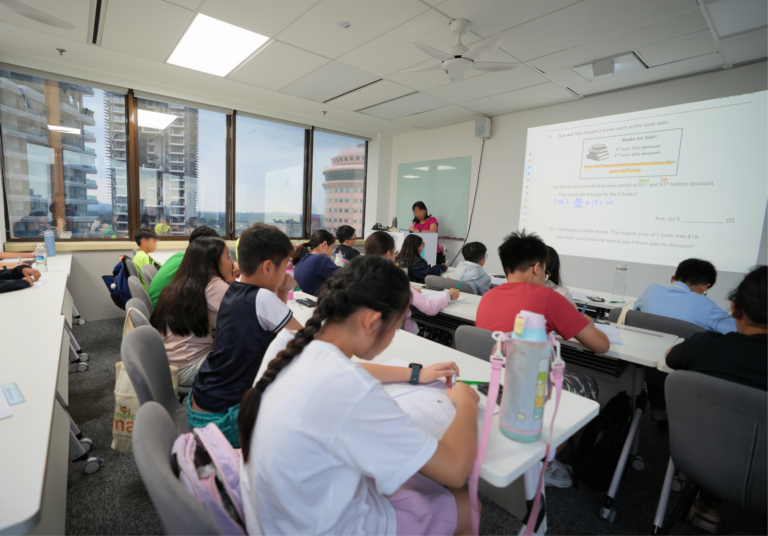
At Concept Math, we simulate exam environments during lessons so children learn to manage time and stress. These mock scenarios help students walk into the real exam with calm confidence.
2. Practise Positive Self-Talk
Mindset matters. Leveraging our L.E.A.R.N approach, we help students reframe challenges with positive affirmations. At the same time, parents play a key role by using encouraging phrases like “just do your best.” Simple words of support can boost your child’s confidence, helping them believe in themselves.
You know your child is all set when they start to show a calm, confident mindset by saying something like:
- “I’ve prepared well.”
- “One step at a time.”
- “Mistakes help me learn.”
What Organisation and Daily Habits to Build
1. Follow a Balanced Study Schedule
Effective math revision lessons aren’t about endless hours. Instead, we focus on smart repetition:
- Timed drills
- Spaced-out topic reviews
- Weekly past-year paper practice
For parents, we recommend that they develop a 3-session daily routine for their children. It covers:
- Session 1: Review concepts
- Session 2: Practise questions
- Session 3: Corrections.
Always end the day with downtime—reading, drawing, or relaxing.
2. Prepare Exam Essentials Early
Think of “T = Test Readiness” in the S.M.A.R.T. approach. Avoid the morning rush and be well-prepared by packing examination essentials the night before.
- Pencils, erasers, and a ruler
- Entry proof
- A water bottle and an optional jacket

At Concept Math, we organise mock tests that include a readiness check to familiarise students with utilising all their tools. Meanwhile, parents should let their child take the lead in packing their own exam kit so they feel less anxious.
3. Prioritise Quality Sleep
Did you know a well-rested child performs better in math? That’s why Concept Math’s L.E.A.R.N. framework focuses on “L = Learn Better with Rest”. We recommend:
- 8 to 9 hours of sleep each night
- No screens after 8:30 PM
- Calming routines like stretching or music before bed
At the same time, treat sleep as an essential part of your child’s revision. A well-rested mind is sharper and more focused, hence reducing careless mistakes. After all, the last thing you want is for your child to walk into the exam exhausted and undo the best preparation.
What is the Next Step?
Whether your child is starting exam prep or deep into past-paper mode, our comprehensive frameworks support students through every stage. If you’re searching for a trusted math tuition at Parkway Parade or other locations, Concept Math is here to help.
Our programmes are crafted with both academic rigour and emotional support in mind, keeping students prepared and capable at all times. Don’t wait until the final months. The earlier good habits begin, the stronger the results come on PSLE day.
Contact us for more information.