PSLE Math Has Changed: What It Means for Your Child
If the Math homework on your child’s desk no longer looks familiar, that isn’t a parenting gap; that’s the revised PSLE Math syllabus doing exactly what it was designed to do. The old syllabus, where pattern recognition and memorised methods were sufficient, has been rewritten.
Today’s Primary Math syllabus tests whether a student can see the invisible links between concepts, which is a shift from formula-finding to problem-solving that changes everything about how school children need to prepare.
Here’s what has truly changed, and why a structured, conceptual approach is the only reliable way to future-proof your child’s Achievement Level score.
1. Key Topics Are Now Introduced Later
One of the most significant structural changes in the new Primary Math syllabus is the redistribution of topics across year levels. Several concepts, including Algebra and Ratio, have been shifted into the Primary 6 curriculum. On the surface, this might seem like a relief: less pressure in earlier years, more time to mature before tackling the harder content.
When foundational topics are taught only in Primary 6, students have significantly less time to absorb, practise, and internalise them before the national examination. The old strategy of “getting serious at the Prelims” is no longer viable. By the time Preliminary Examinations arrive, a student who has yet to build their conceptual foundation will find themselves managing brand-new content under full exam pressure at once; a combination that rarely ends well.
This is why, whether your child is attending Primary 1 Maths tuition or sitting in a P4 Maths tuition class, the work done in the earlier years is no longer just preparation for the next level; it’s the scaffolding for PSLE itself.
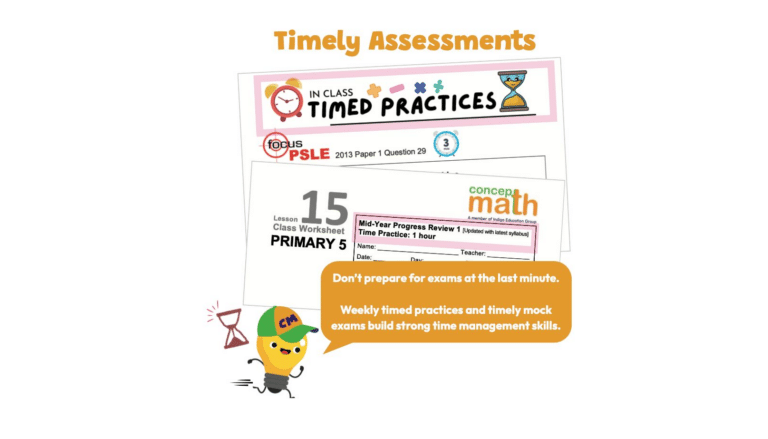
At Concept Math, we bridge this gap by integrating structured, progressive test experiences into our programme well before Primary 6. From the moment students join our Primary Maths tuition class, they’re exposed to a learning environment that simulates the demands of real examination conditions.
2. Thinking, Not Memorisation
Here’s the challenge that the revised PSLE Math syllabus has introduced, and no amount of assessment book drilling can solve: modern PSLE questions no longer stay “in their lane.”
A question is no longer simply a Fractions question or a Ratio question. It’s a question that begins with a ratio, requires fractional reasoning to progress, and concludes with an understanding of how quantities change; all within a single problem, often one that the student has never seen a template for before.
Students who have learned their topics in silos, Fractions in one folder, Ratio in another, Percentage tucked away separately, will freeze when they encounter these hybrid questions. Not because they don’t know the individual concepts, but because they’ve never been taught to see the connection.
This is precisely the gap that our approach at Concept Math is built to close. Whether your child is in a P2 Maths class, in Primary 3 Maths tuition, or attending Primary 5 Maths tuition before PSLE.
Rather than teaching topics as isolated units, we teach the logic that connects them. Our lessons are structured around the recurring conceptual relationships that appear across different topic areas. A student who understands the logic of “parts and wholes,” for instance, can apply that thinking whether the question frames it as a fraction, a ratio, or a percentage. They’re not recognising a question type; they’re reading the structure of the problem itself.
This flexibility, the ability to apply a single concept across seemingly different contexts, is precisely what the revised Primary Math syllabus is designed to reward. And it cannot be drilled in through repetition alone. It must be taught.
3. Conceptual Mistakes Now Cost More Marks
Under the revised syllabus, the stakes attached to conceptual accuracy have risen considerably. In the older format, a mistake early in a question might cost a student one or two marks. In today’s multi-stage problem structures, a small conceptual slip at Step 1 can derail every subsequent step, turning a single misunderstanding into a cascading loss of marks across the entire solution.
This isn’t an accident of design; it’s a deliberate reflection of the syllabus’ intent: to distinguish students who truly understand a concept from those who have learned to imitate its surface patterns. It’s also why the S.M.A.R.T. approach that supports every Concept Math lesson, including PSLE Maths tuition, isn’t a branding exercise, but a practical, stage-by-stage method for navigating complex, multi-layered problems.
Our students are trained to break complex “novel” questions into logical, manageable stages, eliminating the panic that sets in when a problem looks unlike anything they have practised before. They learn to track how quantities change accurately throughout a solution, so that a shift in one variable doesn’t throw off their entire work.
They develop the habit of visualising relationships clearly through model drawing, turning abstract word problems into structured visual frameworks that the mind can work through methodically. They’re also trained to stay calm and analytical, even when the question structure is completely unfamiliar.
For students navigating the new PSLE Math papers, particularly Paper 2, this kind of structured thinking is now a necessity.

Build "Thinking Skills" for the Future
It would be easy to frame everything above purely in terms of examination performance. But the thinking skills developed through this approach extend well beyond the exam hall. These are the same skills used by engineers, coders, and problem-solvers across every discipline. When we teach a P5 student to see the logical connection between ratios and fractions, we’re not just preparing them for a national examination; we’re training them to approach complexity with curiosity rather than anxiety.
This commitment is maintained across all Concept Math locations, including our new centres at Jurong (JTC Summit) and Parkway Parade. We also offer a Maths holiday programme, which is a focused period for students to consolidate concepts and address gaps before the next term begins.
The revised PSLE Math syllabus demands genuine understanding, rewards structured thinking, and exposes the gaps left by rote memorisation. For a student who has learned to see the logic beneath the question, it’s a stage they’re prepared for.