The Real Purpose of Model Drawing in Primary School Math
There’s a comment that circulates in secondary school corridors with remarkable consistency. The moment a child begins learning Algebra, someone will say, “Forget model drawing. You won’t need it anymore.”
It’s said casually, as though years spent mastering bar models were merely a temporary scaffolding to be dismantled the moment something more sophisticated arrived. And it leaves many parents wondering: was all that primary school Math just a very elaborate detour?
The real question is not whether model drawing survives into secondary school, but rather what it was building all along. Model drawing was never designed to be a shortcut for calculation; it’s a framework that trains the logical mind in ways that no formula ever can. Understanding the difference between a thinking and a calculation tool changes everything about how we should value the primary school syllabus.
The Real Goal: Building a Foundation of Logic
When parents think about primary school Math, the conversation almost always gravitates towards one number: the AL score, which is understandable. The PSLE is high-stakes, and results have real consequences for secondary school placement.
But Singapore’s primary school Math curriculum was not designed for scores; it was designed to build logical reasoning and structured problem-solving, two cognitive skills that support success not just in secondary Math, but across every discipline that requires analytical thought.
Consider what a child is doing when they work through a Fractions problem or a Ratio question. They’re not finding an answer; they’re learning to see how quantities relate to one another before they touch an abstract formula. They’re developing what we call visual intuition, which is the ability to look at a complex, wordy situation and instinctively ask: What is the structure here? What do I know, and what am I trying to find?
This intuition is what separates students who thrive with abstract mathematical concepts later in life from those who struggle. Students who were taught to understand relationships carry a cognitive advantage that no amount of formula memorisation can replicate. Topics like Fractions and Ratios are not merely exam content. They’re structured exercises for breaking down complexity into logical, manageable steps.
Why Model Drawing is a Powerful Thinking Framework
Bar modelling, the drawing method at the heart of the Singapore Math curriculum, is one of the most misunderstood tools in primary education. It’s frequently dismissed as a trick to make Math “easier,” or written off as a simplified crutch for younger children who cannot yet handle algebra.
Both views miss the point entirely.
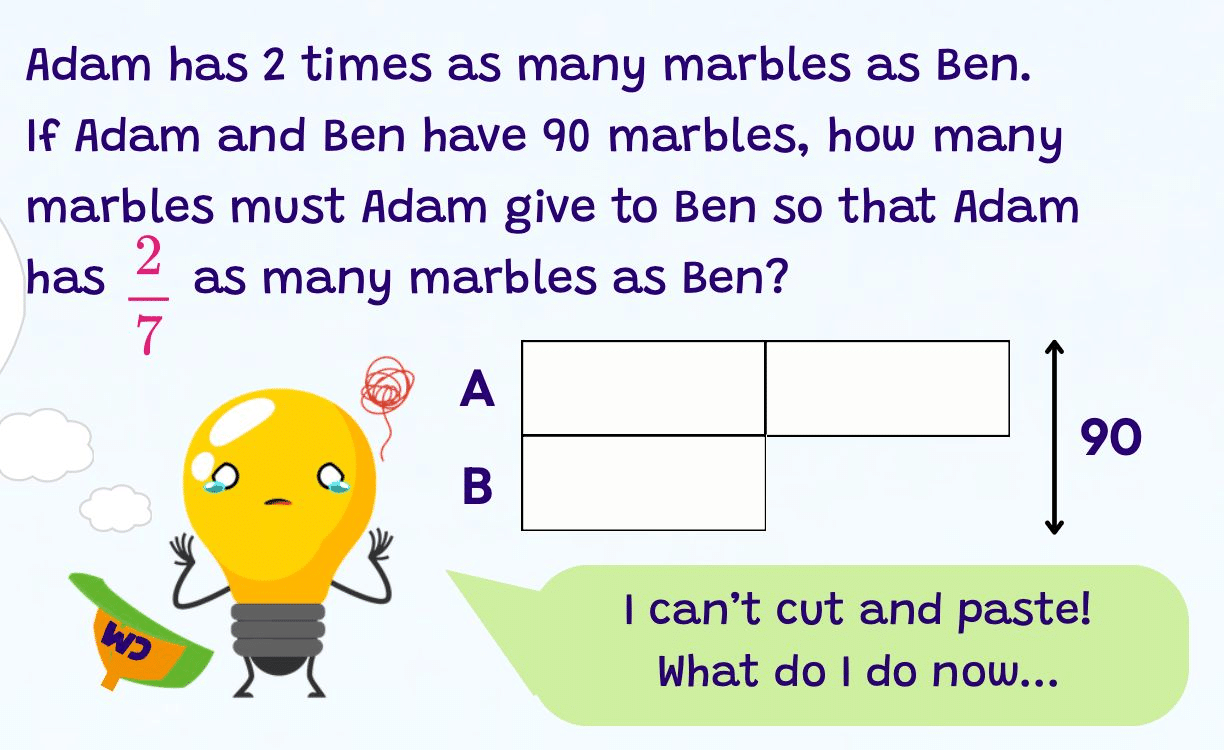
Model drawing was not designed to make Math easier; it was designed to make mathematical relationships visible. When a student draws a bar model for a Ratio problem, they’re not bypassing the thinking but doing the thinking. The act of drawing forces the student to ask, “How do these quantities compare? Which is larger? By how much? How does a change in one affect the other?”
Compare this to a student who memorises a Ratio formula and plugs in numbers. The latter student may arrive at the correct answer, but they have not necessarily understood anything. The moment the question is rephrased, or the ratio involves a change in quantities, or the problem is embedded within a broader multi-step context, which is precisely what modern PSLE Math questions do, the formula-memoriser is lost. The model-drawer, however, simply draws a new model and reads the structure of the new problem. That’s the essence of what drawing does for Math problem-solving: it turns an abstract challenge into a visible, workable structure.
What Model Drawing Actually Trains Your Child
The value of model drawing is best understood not as a single skill, but as a set of cognitive habits that develop through consistent, thoughtful practice. Here’s what is being built every time a student reaches for their pencil and draws a bar:
- Seeing the Structure: Rather than hunting for a formula that matches the question type, a student trained in model drawing looks for the relationships in the problem. This habit of analysing a situation before attempting to solve it is the foundation of logical reasoning across every field.
- Breaking Down Complexity: Multi-stage Math problems, particularly the kind that appear in tuition practice and actual national papers, require students to identify what is known, what is unknown, and the order in which to address each part. Model drawing trains exactly this sequencing skill.
- Translating Language into Structure: Primary school Math questions are translation exercises; converting a paragraph of English words into a precise mathematical relationship. The bar model is the translation tool. A student who can draw an accurate diagram from a word problem has demonstrated genuine comprehension, not just computation.
- Developing Confidence Under Pressure: A child who can visualise a problem feels in control of it. A child who relies entirely on memory feels exposed the moment the question looks unfamiliar. In a P5 Maths class in Singapore, or the actual PSLE, this psychological distinction matters enormously.
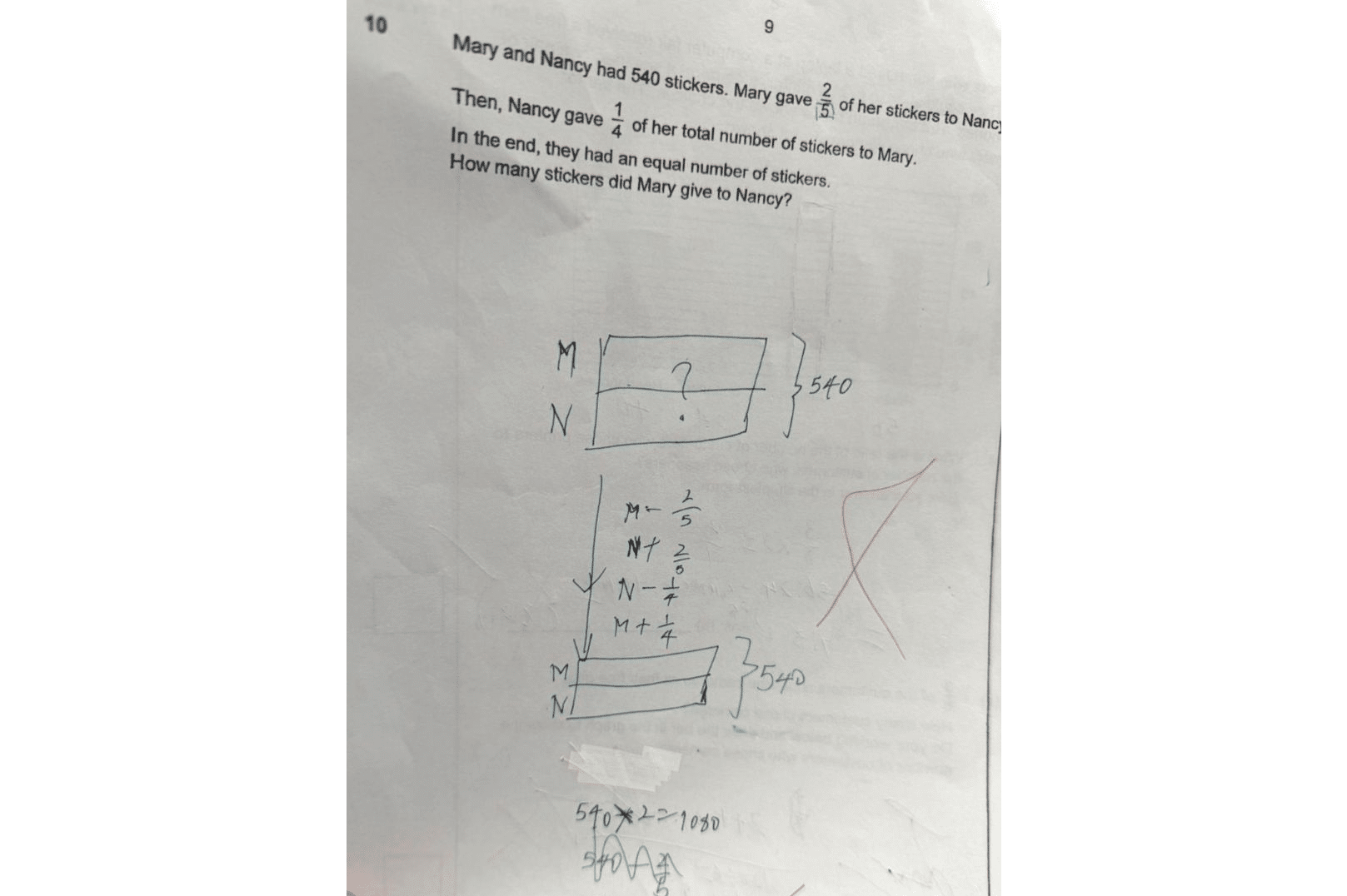
Why the "Useless" Myth Exists
The myth persists because of how model drawing is often taught. When bar modelling is reduced to memorised templates, it becomes exactly as mechanical as its critics claim. A student drilled to match question patterns to model shapes has not learned to think; they have learned to sort. And when a novel question arrives that fits no familiar template, they’re no better than a student who memorised a formula.
At Concept Math, Maths tuition for primary students is built around the reasoning behind every model. When students understand why a bar represents a quantity, and what changes when that quantity shifts, the model doesn’t become obsolete when Algebra arrives; it becomes the foundation upon which algebraic thinking is built. The unknown in a bar model and the unknown in an equation are, conceptually, the same thing.
Training the Mind for the Future
Primary school Math is not a detour, but a deliberate training of a child’s logical mind. These skills don’t disappear at Secondary 1. They become the foundation upon which every subsequent layer of mathematical thinking is built.
Is model drawing useless? Not when it is taught correctly. The real question is whether students understood the thinking behind it. At Concept Math, that has been our focus since 2011, from our earliest learners to students in our PSLE Maths tuition.
We also offer a June holiday Maths camp, a focused programme to consolidate concepts and address gaps before the final stretch of the school year. This approach is delivered consistently across our centres at Parkway Parade and Jurong (JTC Summit), where every student is taught to think before they solve.