PSLE Math: The Study Strategy Most Parents Get Wrong
The home office tells a familiar story, with past-year papers stacked in columns, and assessment books from various publishers. Despite these resources, the child studies for hours every evening, and yet their PSLE Math grades remain flat.
At Concept Math, we call this the Assessment Book Trap. The problem isn’t a lack of effort because the resources are there. What’s missing is a sequence: a clear framework for which materials to use, in what order, and for what purpose.
Parents often search for a simple cheat sheet to cut through the noise around PSLE Math preparation. The honest answer is that the framework is straightforward; the problem is that most students don’t follow it consistently.
The Problem with Too Many Assessment Books
Different publishers often present different solving methods for the same problem type. One book uses algebra. Another uses model drawing. A third uses both interchangeably. A child working across all three simultaneously doesn’t develop a strong method; they develop the habit of reaching for whatever seems familiar first.
This produces a complaint that parents and teachers hear often: “I understand the question, but I don’t know how to start.” That hesitation isn’t a knowledge gap, but a framework gap. The child has too many conflicting tools and no reliable starting point.
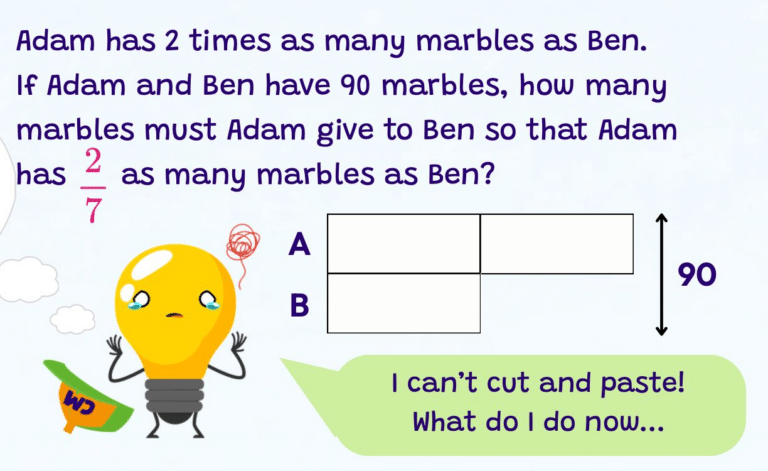
The correction is deliberate consistency. Students of Concept Math follow the Draw → Think → Solve habit for every problem, regardless of question type. A single, reliable framework eliminates the paralysis of choice and holds up under exam conditions.
When to Use Workbooks, Assessment Books, and Exam Papers
These three practice resources serve distinct purposes. Using them at the wrong stage is one of the most common structural errors in PSLE Math preparation.
1. Workbooks
Schools issue workbooks alongside the teaching of each concept, and the timing is deliberate. Workbooks should be assigned immediately after a concept is taught, while the idea is still fresh. The goal at this stage is reinforcement, not challenge. Mistakes here should be corrected before the child moves on.
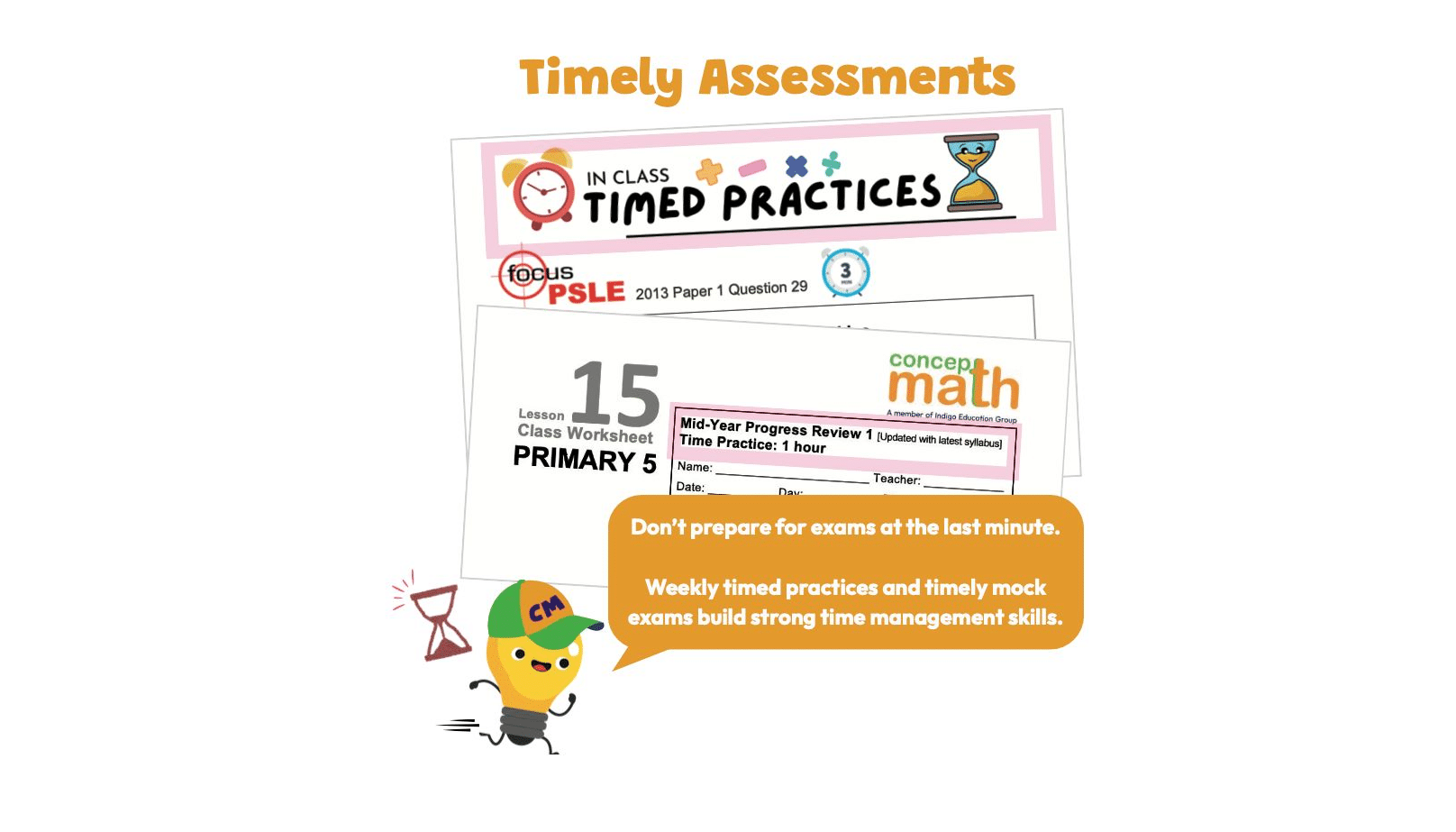
Our in-class worksheets follow the same logic. Teachers work through a model example with the class, then students attempt a closely related variation. The scaffolding is tight: see it done, do a version of it, catch errors early.
2. Assessment Books
Assessment books become useful only once the foundational concept is secure. Their purpose is exposure: to show how the same concept appears across different question formulations and contexts. A child still uncertain of the core idea will find this variety more confusing than clarifying.
One rule worth enforcing at home: even when the answer shows a different method, the child should stay with the framework they have been taught. Switching methods mid-preparation fragments thinking instead of deepening it.
Concept Math’s booster worksheets serve this same function, with varied question structures always delivered within a consistent methodological framework.
3. Exam Papers
The common advice is to save past-year papers for the final revision stretch. That timing misses a better application. Selected PSLE Math questions should be introduced alongside concept teaching from the start, rather than stockpiled for later.
Choosing exam-grade questions that align with the concept currently being studied gives students early exposure to how higher-order PSLE Math questions are framed in that topic. It also builds the critical skill of strategy selection: looking at an unfamiliar question and deciding which approach fits, rather than pattern-matching to a memorised type.
The Most Important Practice Habit: Studying Mistakes
Finishing ten papers and ticking the correct answers amounts to very little. Working through five wrong answers with genuine analysis builds considerably more. The difference isn’t in the number of questions; it’s in whether the student understands why the error occurred.
Students are encouraged to review every incorrect PSLE Math question using the same five-step sequence:
- Did I understand the question correctly?
- Did I accurately present the problem in model or concrete form?
- Did I analyse the correct approach?
- Did I make any careless mistakes in calculation or in transferring numbers?
- Did I test whether my answer is correct?
The order matters. A student who misread the question needs a different correction from one who chose the wrong strategy or made a calculation slip. Identifying which step broke down is what turns a wrong answer into a genuine learning point. Re-solving the question from scratch, without referring to the solution, is what builds the reasoning confidence the revised PSLE Math syllabus now rewards.

How Concept Math Structures Practice
The five-step learning cycle at Concept Math is built around one principle: understanding before volume.
- Clear Concept Teaching: The ‘why’ is established before the ‘how’. Students don’t begin practising until they can articulate what the concept actually means, not just what the steps look like.
- Guided Classwork: Teachers work through problems in real time alongside students, guiding the thinking process rather than presenting solutions. The student’s reasoning is visible at this stage, so misconceptions surface early rather than compounding quietly over weeks.
- Short Timed Segments: Brief, focused checks that confirm whether a student can perform the concept accurately under a clock. Pressure is introduced gradually, not all at once.
- Reinforced Homework: Assignments are targeted rather than broad, designed to build memory through specific recall rather than general repetition.
- Mistake Focus: Errors aren’t marked and moved past; they are the lesson. Students return to incorrect questions, identify which step in their reasoning broke down, and re-solve from scratch.
The sequence is identical across all classes and locations.
For parents exploring maths tuition for primary school, asking a centre to walk through its practice sequence is a useful filter. A centre that can clearly explain its structural approach has thought carefully about how learning compounds over time, not just about how many questions students complete per session.
The same structured approach carries through our maths holiday camp in Singapore, where school holiday periods become an opportunity for focused, sequenced revision rather than another round of undirected paper drilling.
Progress Looks Different When Practice is Structured
The goal of PSLE Math practice is not to complete more questions; it’s to approach an unfamiliar problem with a clear, reliable method. Structured practice builds that capacity; volume alone doesn’t.
If your child’s revision feels repetitive without results, consider enrolling them in a PSLE Maths tuition centre in Singapore that teaches students how to think rather than what to recall.