The P3 Jump: Why P3 Maths Seems Harder
The scene is familiar. A child who sailed through P1 and P2 sits at the kitchen table, pencil in hand, staring at a word problem. The numbers are not large. They know their times tables. But they cannot begin.
This is known as the Question Literacy Gap: the moment when arithmetic fluency alone stops being enough, and the ability to read a maths question structurally becomes the skill that separates students who can start from students who freeze.
P3 is not where primary maths gets harder. It is where it gets different. The syllabus expands in several directions at once, but the more significant shift is not about content volume. It is about what that content now demands of a child’s thinking.
What the P3 Maths Syllabus Actually Introduces
Five areas expand or arrive for the first time at P3.
- Multiplication tables (6, 7, 8, and 9): These complete the full table set, but unlike the 2, 5, and 10 tables, they have fewer obvious patterns and produce larger products.
- Division with remainder: A student’s first encounter with an answer that is not clean. Managing remainders correctly is a thinking habit that recurs in problem sums through P5 and P6.
- Fractions: Equivalent fractions, comparing and ordering unlike fractions, expressing fractions in simplest form, and adding and subtracting related fractions are all introduced at P3.
- The 24-hour clock: Time calculations are a consistent source of errors because the system is not decimal. Sixty minutes make one hour, not one hundred, and students who apply decimal logic to time questions lose marks reliably.
- Area and perimeter, angles, perpendicular and parallel lines: These are not standalone topics. They are the measurement and geometry foundations that P4 and P5 math build directly on.
Why P3 Word Problems Feel So Different
In P1 and P2, a word problem typically tests one skill in one step. P3 maths questions regularly require three or more steps, each building on the result of the previous one. A student who reads a question and immediately starts calculating is now at risk because they are solving before they have understood.
P3 maths exam papers reflect this shift directly. What is a maths word problem at this level? It is no longer a number sentence in disguise. P3 word problems introduce comparison structures, remainder structures, and multi-part questions where information is spread across several sentences. A child who reads a question as a collection of numbers rather than as a structure will miss what is being asked before they write a single figure.
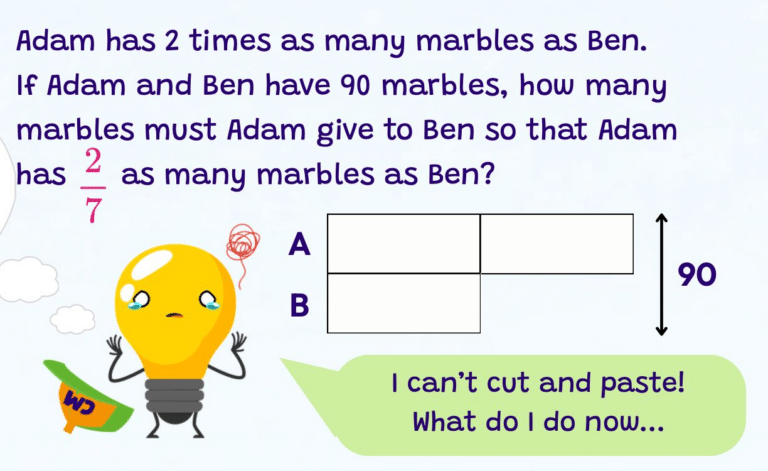
This is where bar models stop being optional. The student who builds the habit of visualising quantities before calculating has a structural advantage as problems grow more complex.
P3 word problems also begin testing time, compound measurement, and geometry in context. A question about elapsed time in a 24-hour clock format requires reading comprehension and number sense working together. Topics can no longer be treated as separate compartments.
The Heuristics That Begin at Primary 3
Heuristic maths refers to the problem-solving strategies for situations where there is no single formula to apply. At P3, students begin encountering maths questions that require selecting a strategy, not just arithmetic. These strategies fall into four broad categories.
Give a Representation
Draw a Diagram · Draw a Bar Model · Make a Table · Make a Systematic List
At P3, these are the most useful. A student who draws a bar model before calculating is not decorating their working. They are converting a language problem into a structure they can reason about.
Make a Calculated Guess
Look for Patterns · Guess and Check
Guess and Check is not random guessing. It is a disciplined method of trying a value, checking it against the conditions of the problem, and adjusting systematically. Look for Patterns asks students to identify a rule from a sequence of examples, training the kind of generalised reasoning that becomes critical in upper primary.
Go Through the Process
Act It Out · Work Backwards · Before-After Concept
Concept Math’s P3 programme introduces Work Backwards and Before-After at this level, alongside Guess and Check. Work Backwards in simple P3 contexts, for example, finding a starting quantity when the end result is known, trains a student to identify what a problem is asking before deciding where to begin.
Simplify the Problem
Simplify the Problem · Solve Part of the Problem
At P3, these strategies introduce the idea that a complex maths question does not have to be solved all at once. Breaking it into smaller, independently solvable parts is a skill that becomes essential in P5 and P6 multi-step problem sums.
The goal across all four categories is not to master every heuristic at P3. It is to build Question Literacy: the habit of reading a problem for its structure, identifying what is known and what is being asked, and choosing which approach the problem calls for.
The P3 Gaps That Follow a Child Into Upper Primary
Three gaps from P3 carry forward quietly, often surfacing only once the stakes are higher.
- Equivalent fractions: A student who memorises the procedure without understanding equivalence will struggle with ratio in P5, which relies on the same conceptual logic. The gap travels forward quietly, often before P4.
- Multiplication table fluency: The 6, 7, 8, and 9 tables appear in every multi-step problem sum through PSLE. Slow retrieval at P5 costs the reasoning capacity a problem sum actually needs.
- Bar model habits: A student never taught to draw before calculating at P3 will resist the habit at P5, when it becomes the primary tool for ratio and fraction problem sums. Building it early is far easier than retrofitting it later.
How Concept Math Builds These Habits at P3
At Concept Math, the Draw-Think-Solve framework is introduced from lower primary, so that P3 is not the first time a child encounters structured visual problem-solving. By the time a student reaches P3, the habit of drawing before calculating is already forming.
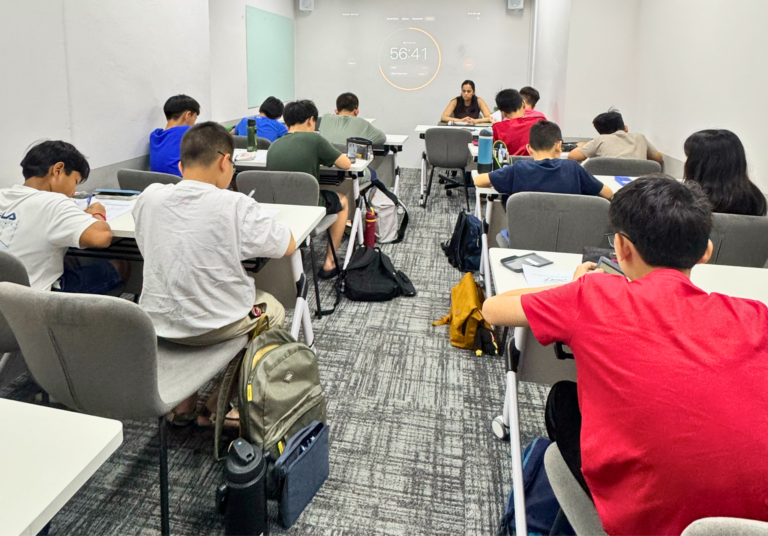
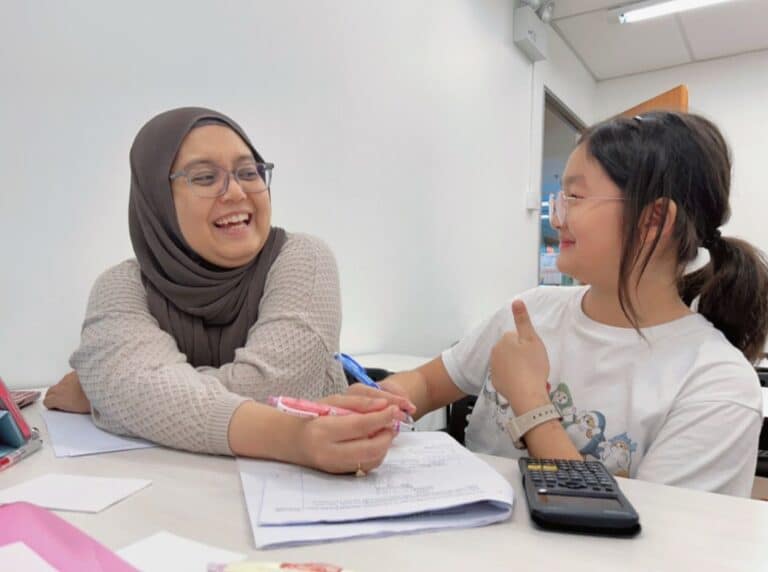
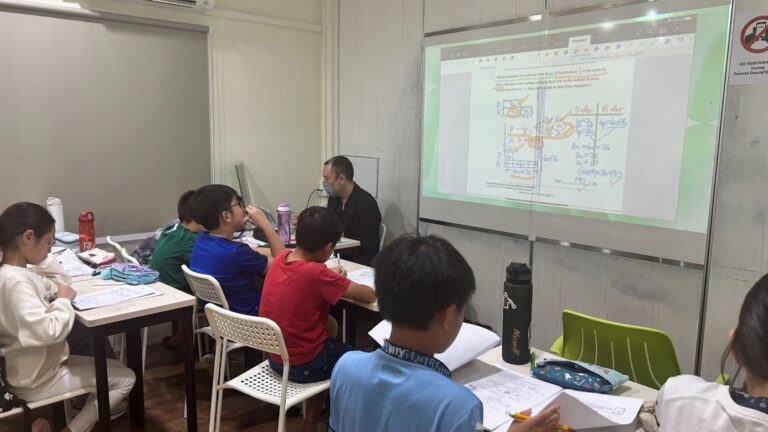
Small-group lessons create space for students to verbalise their thinking on P3 word problems. When a child explains what a question is asking before solving it, the teacher immediately sees whether conceptual understanding is present or whether the child is pattern-matching off the numbers. That distinction is visible in a small group. It is invisible in a worksheet pile.
Every lesson is built around the MOE syllabus while simultaneously laying the foundation for bar models and question-reading habits that P4, P5, and PSLE will rely on.
If your child is finding P3 maths difficult, a trial lesson at our P3 maths tuition class is the simplest way to see the Draw-Think-Solve approach in action. For support across all primary levels, our primary maths tuition programme runs from P1 through P6.