Sort the Questions, Not the Topics: A Smarter Way to Prepare for Math Exams
It is exam season, so there is a stack of papers somewhere in your home. Your child did three of them this week. You marked them. The scores have barely moved, and the same kinds of questions keep coming back wrong.
Most primary school math exam preparation is measured in papers completed, because papers completed is the easiest thing to count. It is also the least useful thing to count.
Paper after paper is not a revision plan
Ask around and most families are running one of two systems, or borrowing someone else’s.
The first is topical sorting. All the fraction questions together, then all the ratio questions, then all the volume questions. There is real value in this when a child has a specific understanding gap in that topic to close.
The second is the past-paper marathon. Paper after paper, timed, marked, filed. Volume without diagnosis just repeats the same mistakes more efficiently.
The third is the most common of all: following a plan that worked for someone else’s child. A revision plan built for a child who is two marks off the top band will do very little for a child who is trying to pass, and it can quietly damage a child who has started to believe they are bad at math.
Revision cannot be one size fits all
A good revision plan works the way a video game works. You do not start on the final level. You clear a level, the game confirms you can hold what you have learned, and only then does it hand you something harder. Every level is chosen for where the player currently is.

Practice is the same. The question is never “how many questions did my child do this week”. It is “which questions, and why those ones”. To answer that, you need a way of sorting questions that has nothing to do with topic.
The four types of question in every math paper
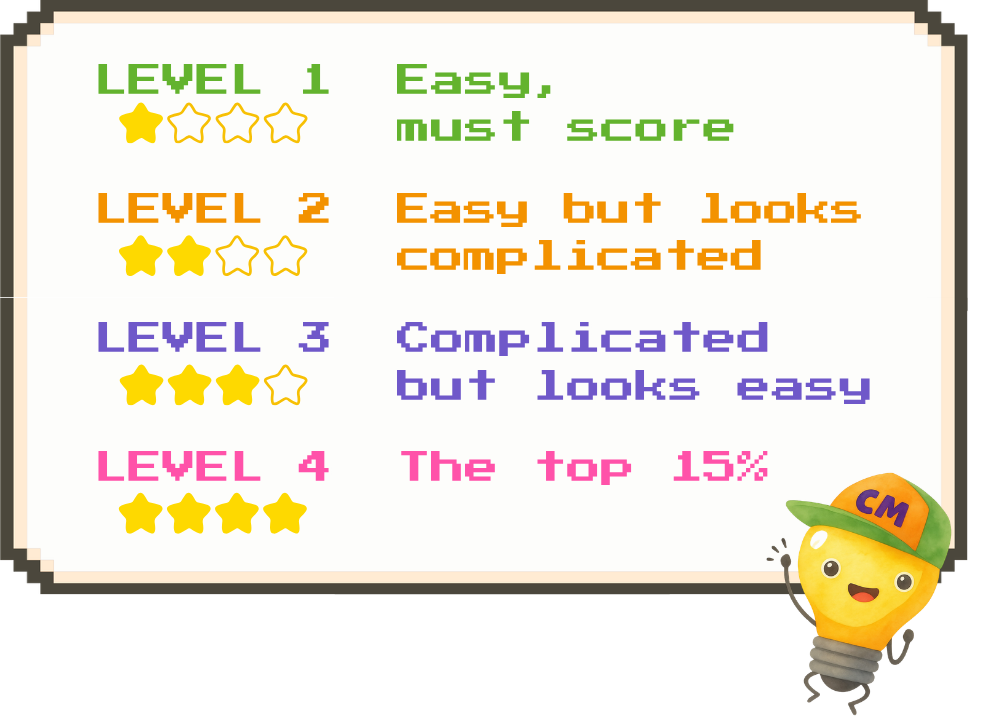
We sort every paper we teach from into four types.
Type 1: the easy, must-score question

One step, one concept, no disguise. From these questions, you can tell
- exactly where are the topical gaps and work on it – this is the easiest gap to fix and should be fixed quickly.
- Suitable for students who needs to pass math
- Suitable for students who are frightened of math and needs to feel capable again before anything harder will go in.
Confidence is not a soft outcome. A child who starts a paper with four quick correct answers reads the fifth question far more calmly than one who has already been ambushed.
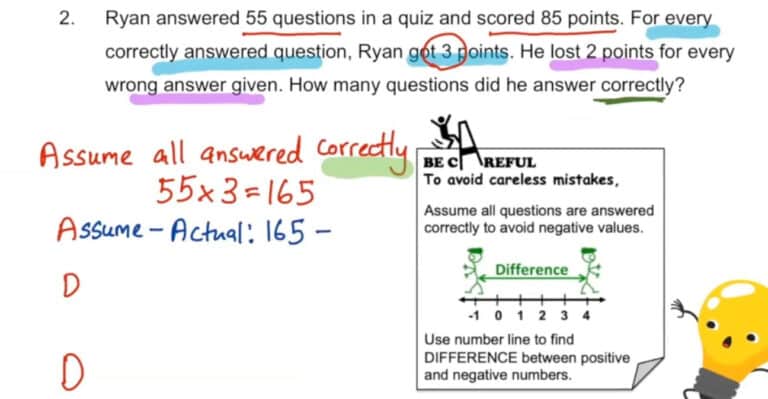
Type 2: the easy question that looks complicated

It reads like a difficult question but it is not. A child with a consistent way of approaching question and analysing it will be able to solve this within two minutes.
A large share of the marks in any exam paper lies in this type of questions. Being able to conquer such question will be the results differentiator. It is also the band that cannot be fixed in three weeks, because it does not depend on knowing a topic. It depends on having one consistent way of thinking, and one consistent method for each concept, so that a long question does not become a guessing game about which of five approaches to try.
Suitable for students who
- Are strong in topical knowledge but gets completely undone the moment a question is phrased differently. That child does not need more content. They need the same approach applied often enough that it becomes automatic.
Type 3: the complicated question that looks easy

No fractions in sight. A child answers it in their head — and gets it confidently wrong. The damage is rarely just that one question. It is the four questions afterwards, attempted by a child who senses something has gone wrong but cannot quite identify what.
Practising questions like these builds two exam skills that content revision alone cannot: laying out working clearly enough to earn method marks even when the final answer does not arrive, and having the discipline to stop, mark the question, and move on instead of spending eleven minutes stuck on it. These are not just Maths skills; they are exam-management skills that can protect marks across the entire paper.
Type 4: the top 15%, the sifting questions

These exist to separate the strongest mathematical thinkers, and they are a small part of any paper. Here is the part parents rarely hear said plainly: missing the hardest question or two does not, on its own, cost a child a top band, provided everything before it was handled cleanly.
A child should only be practising these once the first three types are genuinely secure. Handed to a child who is still shaky on Type 2, they do real harm. They confirm the story that child is already telling themselves, which is that math is something other people are good at. Spending the final month here while Type 2 is unstable is the most common way families waste the time they have left.
Why we choose and sequence questions the way we do
Practice does not make perfect. Intentional practice does. Two children can complete the same forty questions in a week and get completely different value from them, depending on which forty and in what order.
At Concept Math, question selection is a teaching decision, not an admin one. Within every topic and at every level, questions are released in sequence.
Three things have to be aligned for a math programme to work, and most only have one or two:
- One consistent approach, P1 to P6. One method per concept, taught the same way at every level, so nothing has to be unlearned and no child is confused by being shown a second way in P5.
- Intentional selection and sequencing of questions. The right question at the right time for that child, not whatever came next in the book.
- A proven way of teaching and learning it to ensure that gaps can be quickly closed.
Get all three aligned and something quietly important happens. The child keeps believing math is manageable. That belief is doing more work than any single technique, because a child who thinks math is manageable will attempt the long question. A child who does not will leave it blank and call it hard.
What to do at home in the next three weeks
- Sort one paper instead of doing three. Sit with your child and go through a paper without solving anything. For each question, they say which of the four types it is and why. Fifteen minutes, and it teaches more than ninety minutes of silent answering.
- Triage the papers already marked. Mark each wrong answer by type. A page of Type 1 errors is a topical gap or a pacing problem. A page of Type 2 errors is a method problem, and more papers will not fix it. A page of Type 3 errors is usually a rushing problem.
- Match the practice to the child, not to the level. A child who needs to pass should be spending most of their time on Types 1 and 2. Borrowing a plan built for a child chasing the top band will not help them.
- Give a nervous child Type 1 questions on purpose. As a deliberate reset before harder work, not as filler.
- Agree in advance what happens at a Type 4 question. Attempt the setup, write down what is known, move on, return if there is time. Panic in an exam hall is usually the absence of a plan rather than a lack of ability.
The point of practice is not volume
Good math exam preparation is not about how many papers a child finishes. It is about whether they can look at a question they have never seen and know what it is asking, and whether they still believe they can get there. Both are built by teaching one consistent method from P1 to P6 and choosing every question on purpose.
If you would like to see how your child reads a question rather than just what they score, our teachers at Concept Math are happy to work through a paper with them and show you exactly which of the four types is costing the marks.